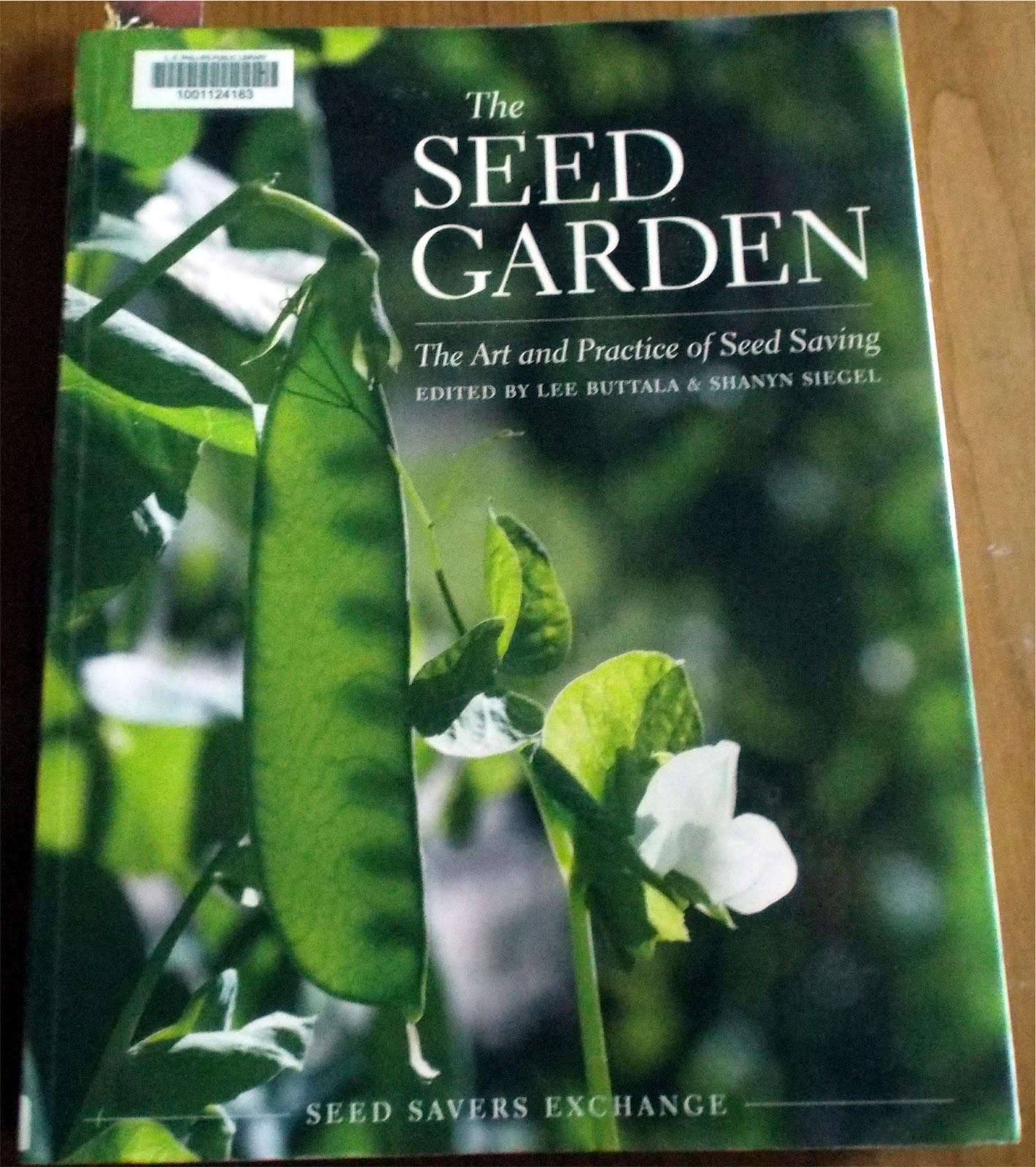
The Seed Garden: The Art and Practice of Seed Saving edited by Lee Butalla and Shanyn Siegel
(click on the link above to buy the book on Amazon)
One thing I'd like to do more in my garden is saving my own seed, but to be honest, I know just enough to know I don't know enough to do it well! I know, for example, that I need to have a large enough planting to avoid inbreeding in certain crops (although self-pollinating crops, like beans, don't have this problem) - but which ones were self-pollinating again? And for those that do cross-pollinate, which crops do they cross with, and how much spacing do I need between them? When it's harvesting time, how do I know when my seeds are fully mature, and how do I dry and store them? I remember that tomato seeds need to be soaked and fermented before they're ready, but what other seeds need this? And which ones need a cold period?
I could hunt down information online about each crop when I was planning my garden, and again when I was harvesting seeds, but in the hustle of summer harvesting, who's got time for that? And in January when I'm planning my garden, my kitchen table is already overflowing with books on companion planting, how-much-to-grow-for-how-many-people charts, lists of how much our family ate last year, and of course seed catalogs! There's no room for seed-saving research for a dozen different plants.
That's why this book is a Godsend. In one handy, indexed volume are 230 pages of crop-by-crop descriptions of everything you need to know about each crop (usually two or three pages per crop), including history of the plant and its common uses, how to grow it for seed (not necessarily the same as growing it for food), pollination requirements, variety maintenance concerns (isolation distances, inbreeding depression, specific traits to select for, etc.), how to tell when your seed is fully mature, and how to dry and store your seed.
And if you don't know why all of that matters, the first 119 pages of the book are like a Seed Saving 101 course, giving you the whys and hows of seed saving and basic plant genetics (but in a very friendly and understandable way). This book is packed with information, and would be useful for both the first-time seed saver and the expert, who would welcome having all of this information at his fingertips. Much more comprehensive than other books on the subject (but not overwhelmingly so), this handy reference would be a useful addition to every gardener's bookshelf.
*** I should note that although this book is pretty comprehensive in respect to vegetable varieties, it does not cover flowers or herbs (I'm assuming they chose not to because of the sheer size that volume would have to be!) For those, I will be keeping my old copy of Seed Sowing and Saving by Carole Turner, which lists basic information for saving both vegetable and common herb and flower seed (although it's by no means as extensive in terms of vegetable crops as The Seed Garden, or as comprehensive in the information about each plant - Seed Sowing and Saving mostly just covers how to preserve the seed, and basic planting requirements).
Note: I was not payed to review this book, I just really love it! But
if you click on the link above and buy the book at amazon.com, I will
receive a small commission from the sale. Thank you for your support!
Showing posts with label Book Review. Show all posts
Saturday, February 13, 2016
Favorite Books of 2015 #2 - The Art of Natural Cheesemaking
The Art of Natural Cheesemaking: Using Traditional, Non-Industrial Methods and Raw Ingredients to Make the World's Best Cheese by David Asher
(click the link above to buy it on Amazon)
I am so excited about this book! I knew, deep down, that people made cheese before the advent of stainless steel and mail-order bacterial culture packets, but I couldn't find any information on how. I'd catch glimpses in cheesemaking books (usually glossed over under a quick "history of cheesemaking" section), or on over-my-head technical websites on bacteriology, but never anything I could really use. Until now . . .
From the first two paragraphs of the introduction, all the way to Appendix E (Comparison of Microorganisms in Commonly Used Starters, Raw Milk, and Kefir), this book answers all of my questions (and quite a few I didn't know enough to ask). And best of all, it's full of recipes! I discovered that my "Homemade Press-Less Raw Cheddar Cheese" isn't really a true cheddar at all - "cheddaring" is actually a term referring to the way the cheese is cut, stacked, and pressed. But it does match pretty closely with his recipe for Basic Rennet Cheese, which is a sort of "blank" cheese that can then be made into cheddar, mozzarella, blue cheese, Camembert, feta, or Gouda, depending on the steps that follow. So technically, my recipe is for cheddar cheese that hasn't been cheddared! Asher does note, however, that "this fresh cheese is eaten in vast quantities in Europe, the Middle East, and Central and South America." Apparently, then, my family is in good company - they eat this fresh cheese in vast quantities, too!
As I mentioned, one reason I was excited about this book was the idea of making cheese without packaged bacterial starter cultures. I knew it could be done (I'd made cottage cheese out of raw milk without adding any starter culture at all, just rennet), but I wasn't about to risk four gallons of precious milk on an experiment I wasn't sure would work. Knowing that someone who knows what he's doing uses this technique on a regular basis gave me the confidence to try it.
So how does he get around using mail-order cultures? He uses either kefir or active whey (leftover from a previous batch of cheese, and thus host to the bacteria needed to make another batch). I chose to use kefir, mainly because of the catch-22 that I wouldn't have any active whey until I'd made a batch of cheese with the proper bacteria - which I wouldn't have until I had some active whey . . .
At first I thought perhaps I could just use whey from a batch of cheese I'd made with my freeze-dried cultures, but Asher says this isn't a good idea: "Cheesemakers can not reculture their DVIs [Direct Vat Innoculants - purchased freeze-dried cultures]. They are unstable collections of bacteria that do not exist in nature, whose profiles change over time, and whose performance and quality will decline if reused. Much like the unpropagatable hybrid seeds that many farmers use, DVIs must be purchased anew for every batch of cheese. Cheesemakers, therefore, become dependent upon purchased packaged cultures. Even if it were possible, reculturing the proprietary blends of often trademarked cultures may not even be permitted!"
So that left kefir as my best option for a sustainable starter culture. Kefir grains (which are not really grains like wheat or oats, but rather a symbiotic colony of bacteria and yeasts - similar to a kombucha SCOBY, although they look completely different and host different microbes). Thankfully, a friend of mine had some extra kefir grains she was willing to share (kefir colonies grow quickly, and need to be divided regularly), and by the end of the week my kefir production was cruising right along. To keep my grains healthy, I need to feed them much more than I'd need just for once-a-week cheesemaking, so we mix the extra with bananas and blueberries each morning for a tasty probiotic breakfast smoothie.
Now that I have my kefir ready to go, I can make almost any kind of cheese in the book (other than blue cheese - to get the tasty blue bloom, I'd need to grow some Penecillium roqueforti - which Asher claims is easy to do on homemade sourdough bread. He even shares his sourdough recipe in Appendix A!) The recipes are all very simple and straightforward, and if you do run into a problem, he includes a troubleshooting guide in Appendix D, covering all of the cheese recipes in the book. Whether you're a beginning cheesemaker or just looking for a more sustainable way to make your homemade cheese, this book is full of useful information for anyone who wants to make good cheese.
Note: I was not payed to review this book, I just really love it! But if you click on the link above and buy the book at amazon.com, I will receive a small commission from the sale. Thank you for your support!
(click the link above to buy it on Amazon)
I am so excited about this book! I knew, deep down, that people made cheese before the advent of stainless steel and mail-order bacterial culture packets, but I couldn't find any information on how. I'd catch glimpses in cheesemaking books (usually glossed over under a quick "history of cheesemaking" section), or on over-my-head technical websites on bacteriology, but never anything I could really use. Until now . . .
From the first two paragraphs of the introduction, all the way to Appendix E (Comparison of Microorganisms in Commonly Used Starters, Raw Milk, and Kefir), this book answers all of my questions (and quite a few I didn't know enough to ask). And best of all, it's full of recipes! I discovered that my "Homemade Press-Less Raw Cheddar Cheese" isn't really a true cheddar at all - "cheddaring" is actually a term referring to the way the cheese is cut, stacked, and pressed. But it does match pretty closely with his recipe for Basic Rennet Cheese, which is a sort of "blank" cheese that can then be made into cheddar, mozzarella, blue cheese, Camembert, feta, or Gouda, depending on the steps that follow. So technically, my recipe is for cheddar cheese that hasn't been cheddared! Asher does note, however, that "this fresh cheese is eaten in vast quantities in Europe, the Middle East, and Central and South America." Apparently, then, my family is in good company - they eat this fresh cheese in vast quantities, too!
As I mentioned, one reason I was excited about this book was the idea of making cheese without packaged bacterial starter cultures. I knew it could be done (I'd made cottage cheese out of raw milk without adding any starter culture at all, just rennet), but I wasn't about to risk four gallons of precious milk on an experiment I wasn't sure would work. Knowing that someone who knows what he's doing uses this technique on a regular basis gave me the confidence to try it.
So how does he get around using mail-order cultures? He uses either kefir or active whey (leftover from a previous batch of cheese, and thus host to the bacteria needed to make another batch). I chose to use kefir, mainly because of the catch-22 that I wouldn't have any active whey until I'd made a batch of cheese with the proper bacteria - which I wouldn't have until I had some active whey . . .
At first I thought perhaps I could just use whey from a batch of cheese I'd made with my freeze-dried cultures, but Asher says this isn't a good idea: "Cheesemakers can not reculture their DVIs [Direct Vat Innoculants - purchased freeze-dried cultures]. They are unstable collections of bacteria that do not exist in nature, whose profiles change over time, and whose performance and quality will decline if reused. Much like the unpropagatable hybrid seeds that many farmers use, DVIs must be purchased anew for every batch of cheese. Cheesemakers, therefore, become dependent upon purchased packaged cultures. Even if it were possible, reculturing the proprietary blends of often trademarked cultures may not even be permitted!"
So that left kefir as my best option for a sustainable starter culture. Kefir grains (which are not really grains like wheat or oats, but rather a symbiotic colony of bacteria and yeasts - similar to a kombucha SCOBY, although they look completely different and host different microbes). Thankfully, a friend of mine had some extra kefir grains she was willing to share (kefir colonies grow quickly, and need to be divided regularly), and by the end of the week my kefir production was cruising right along. To keep my grains healthy, I need to feed them much more than I'd need just for once-a-week cheesemaking, so we mix the extra with bananas and blueberries each morning for a tasty probiotic breakfast smoothie.
Now that I have my kefir ready to go, I can make almost any kind of cheese in the book (other than blue cheese - to get the tasty blue bloom, I'd need to grow some Penecillium roqueforti - which Asher claims is easy to do on homemade sourdough bread. He even shares his sourdough recipe in Appendix A!) The recipes are all very simple and straightforward, and if you do run into a problem, he includes a troubleshooting guide in Appendix D, covering all of the cheese recipes in the book. Whether you're a beginning cheesemaker or just looking for a more sustainable way to make your homemade cheese, this book is full of useful information for anyone who wants to make good cheese.
Note: I was not payed to review this book, I just really love it! But if you click on the link above and buy the book at amazon.com, I will receive a small commission from the sale. Thank you for your support!
Favorite Books of 2015 #1 - The Nourishing Homestead
The Nourishing Homestead: One Back-to-the-Land Family's Plan for Cultivating Soil, Skills, and Spirit by Ben Hewitt
(click the link above to buy it on Amazon)
I love this book. It has everything I love to read in a homesteading book, all rolled into one: stories, recipes, how-to, and inspiration, all in an easy-to-read conversational style from someone who's living the life he's describing. It's not all sunshine and rainbows - he freely discusses the trials inherent in farm life, the struggles they've faced, and mistakes they've made. It's a practical and philosophical discussion of their life building a homestead.
One of the main themes throughout the book is his idea of economics - not necessarily how much fiduciary capital you can accumulate (although he's not against money), but how much joy, fulfillment, and purpose you gain or give up in exchange for the time and effort you expend. Working 40 hour weeks in an office might earn you a bigger paycheck, but is that worth the loss to your physical health and relationships? Not to mention the satisfaction of seeing your efforts result directly in producing the things your family needs (like food, shelter, clothing, etc.)
I really appreciate that, like me, one of their family's main reasons for pursuing the homestead life is a recognition that home-grown food, with a focus on soil and animal health, is crucial to promoting your family's health. There are many reasons for homesteading (some more reasonable than others), but this is one that really resonates with me.
In pursuit of their goal of healthier food for their family, they focus on both gardening and animal husbandry (devoting a chapter to each, plus a chapter on animal slaughter and processing). The fourth chapter in particular details their research and reasons for farming and cooking as they do. But the book (and the lifestyle) are about much more than food, as chapter 9, Money and "Stuff", describes. The final chapter, Children on the Homestead, particularly struck a chord with me, since we also homeschool and try to involve our kids into our daily homesteading tasks. Although I don't completely agree with all of their choices (we don't "unschool", and we make sure our Christian worldview is integrated into all of our studies), I do agree with much of their philosophy.
This is one book that I knew I'd have to buy as soon as I started reading - the sheet of paper I was using as a bookmark was completely covered in book recommendations, garden tips, project ideas, and recipes before I was even halfway through reading! It was definitely worth purchasing a copy rather than trying to write down (and then not lose . . .) all of those great ideas. I have a feeling this will be a book I come back to often as our family works on cultivating soil, skills, and spirit on our homestead.
Note: I was not payed to review this book, I just really love it! But if you click on the link above and buy the book at amazon.com, I will receive a small commission from the sale. Thank you for your support!
(click the link above to buy it on Amazon)
I love this book. It has everything I love to read in a homesteading book, all rolled into one: stories, recipes, how-to, and inspiration, all in an easy-to-read conversational style from someone who's living the life he's describing. It's not all sunshine and rainbows - he freely discusses the trials inherent in farm life, the struggles they've faced, and mistakes they've made. It's a practical and philosophical discussion of their life building a homestead.
One of the main themes throughout the book is his idea of economics - not necessarily how much fiduciary capital you can accumulate (although he's not against money), but how much joy, fulfillment, and purpose you gain or give up in exchange for the time and effort you expend. Working 40 hour weeks in an office might earn you a bigger paycheck, but is that worth the loss to your physical health and relationships? Not to mention the satisfaction of seeing your efforts result directly in producing the things your family needs (like food, shelter, clothing, etc.)
I really appreciate that, like me, one of their family's main reasons for pursuing the homestead life is a recognition that home-grown food, with a focus on soil and animal health, is crucial to promoting your family's health. There are many reasons for homesteading (some more reasonable than others), but this is one that really resonates with me.
In pursuit of their goal of healthier food for their family, they focus on both gardening and animal husbandry (devoting a chapter to each, plus a chapter on animal slaughter and processing). The fourth chapter in particular details their research and reasons for farming and cooking as they do. But the book (and the lifestyle) are about much more than food, as chapter 9, Money and "Stuff", describes. The final chapter, Children on the Homestead, particularly struck a chord with me, since we also homeschool and try to involve our kids into our daily homesteading tasks. Although I don't completely agree with all of their choices (we don't "unschool", and we make sure our Christian worldview is integrated into all of our studies), I do agree with much of their philosophy.
This is one book that I knew I'd have to buy as soon as I started reading - the sheet of paper I was using as a bookmark was completely covered in book recommendations, garden tips, project ideas, and recipes before I was even halfway through reading! It was definitely worth purchasing a copy rather than trying to write down (and then not lose . . .) all of those great ideas. I have a feeling this will be a book I come back to often as our family works on cultivating soil, skills, and spirit on our homestead.
Note: I was not payed to review this book, I just really love it! But if you click on the link above and buy the book at amazon.com, I will receive a small commission from the sale. Thank you for your support!
Saturday, February 2, 2013
Book Review: Nourishing Traditions
Nourishing Traditions: The Cookbook that Challenges Politically Correct Nutrition and the Diet Dictocrats
By Sally Fallon with Mary G. Enig, Ph.D
You may have noticed that many of the recipes on this blog that I label "Healthy" don't exactly fit the typical low-fat, low-cholesterol mold. This book is why.
It all started when I joined a now-defunct yahoo group called New Harvest Homestead, all about, well, what this blog is about - raising food for your family on your own "homestead" - be that a few acres in the country, a city lot, or an apartment with a membership to a CSA or community garden. I found that many of the women in the group kept referring to Nourishing Traditions. Intrigued, I went to my library's website to place a hold and found I would be in place 130 waiting for 3 copies! Not sure of what other option I might have (I'm too
That summer, my brother-in-law and his family lived with us while they looked for a house in the area. As fall approached and they prepared to move into their new house, I was helping my sister-in-law pack when I found, to my astonishment, that she had a copy of Nourishing Traditions. Here it had been, sitting on a shelf in my very own house for three months, while I waited impatiently for the library copy to become available!
Of course I asked if I could borrow it, and she readily agreed, and so I sat down and started reading the first chance I had. I was hooked (I never did give her book back - when I'd finally read it through, I figured it would be easier to buy her a new copy so I wouldn't have to move all of my bookmarks!)
Although technically a cookbook, this book is more a treatise on how healthy people the world over have eaten since the dawn of time, how we've abandoned their healthy eating habits in the last few hundred years, and the dramatic decline in our health because of it. It's incredibly dense with research - the recipes don't start until page 82, and even these are heavily sidebarred with scientific studies, quotes, and other relevant information. It took me a year to get through it cover to cover, and I'm an avid reader!
The book is based on the research of Weston A. Price, a dentist who travelled the world in the 1930s seeking out isolated groups of people who still ate the way their ancestors had eaten for thousands of years, and specifically looking at how their diet influenced their teeth and dental structure. He published his findings in the book Nutrition and Physical Degeneration, which became a seminal work in the Traditional Foods movement. He found that not only were the people who ate their ancestral diets more healthy, with fewer cavities and degenerative diseases, but that when people began to eat more "modern" foods (most specifically white flour and refined sugars) that their health declined dramatically.
Nourishing Traditions, then, is based on Price's research, but also draws heavily from research done in the many decades since then. Time and again, science points to the fact that a healthy body is fed by foods rich in nutrients, and that "empty calories" not only don't satisfy our hunger, they actively harm our long-term health.
But it's not just another "fad" diet - in fact, it's the anti-fad diet. There aren't any new, expensive products to buy to pad the author's pocket; instead the book calls for a return to the healthy, nourishing foods our ancestors ate - grass-fed meats, fermented foods (think sourdough bread, sauerkraut and yogurt), soups based on rich bone broth, and as-fresh-from-the-farm-as-you-can-get-it clean dairy products.
For me, it just made a lot of sense. If you want to know how to be healthy, look to people who are healthy, and who have maintained that level of health for generations. Then figure out how you can do likewise - for your own sake, and your children's. It can be a big change - for the most part, it means cooking from scratch - it's hard to find restaurants who use traditional foods rather than pre-packaged ingredients, and those that do are often out of a normal family's price range. But the way I see it, time and money invested on nourishing your body will pay off both now and in the future - if you could avoid many of the degenerative illnesses of our time and remain healthy and productive throughout your life, wouldn't that be worth it?
I've been slowly implementing more and more of this philosophy into our diets over the last 5 years (it's definitely not something you can do all at once!), and I can already see improvement in my own health, as well as in my husband and children. One baby step at a time, we're eating better every day, and getting healthier every day.
And it all started when I read this book.
Sunday, December 9, 2012
Book Review: The Weekend Homesteader
The Weekend Homesteader: A Twelve-Month Guide to Self-Sufficiency by Anna Hess
As a fan of Anna and Mark Hess's blog, The Walden Effect, I knew this book would be full of interesting projects and useful information. When she wrote that she was offering free copies to bloggers who would write a review, of course I signed up right away!
I was giddy when the book arrived in the mail in October (happy birthday to me!) The publisher asked that we try to time the review to coincide with the book's release in mid-November, and since the book didn't look too thick (about 400 pages) I figured I'd be done in plenty of time.
Obviously not!
Although October and November were very busy for our family, the real reason I couldn't get through this book as quickly as I'd thought was because I wanted to try all of the projects! The book is set up with a chapter for every weekend through a whole year (for example, the project for the first week of August is "Seed Saving"). Each project lists its goal ("Save seeds from the easiest vegetables in your garden"), cost ("$0 to $10), time ("1 hour to 4 hours"), difficulty ("Easy to medium"), and kid-friendly rating (generally yes, no, or maybe). After a short section on the reasons each project is worth trying, she dives right into the meaty how-to.
This book is great for the raw beginner, eager to get her hands dirty but not sure where to start, as well as for a homesteader who's been working at it for a few years (we all have something to learn!) I know I, for one, get excited reading about ideas in books or online, but balk at actually starting projects because I'm not sure exactly how to get going. This book lays everything out so clearly I feel like I could just jump up and get started as soon as I finish the chapter (although some of my bookmarked projects, like "Growing edible mushrooms" will require a little more waiting - I have to order the spawn plugs, after all . . .)
So, you ask, what were the projects I was so excited about? The first one that really caught my interest (only because the previous three chapters (Find room to homestead, Survey your site, and Plan your summer garden) were projects I had already done) was the chapter entitled "Kill Mulch", which included a section on Hugelkultur - creating raised beds by burying rotting wood and compost (I actually just tried this in my garden this week!)
The book isn't just gardening ideas, either. She includes projects like making your own seasonings, soups, and breads, storing vegetables on the shelf, canning, drying, and other kitchen-related tasks, as well as more abstract assignments like figuring your real hourly wage, budgeting, thinking about voluntary simplicity, and realistic goal setting. There's a chapter on building a chicken coop or tractor and one on staying warm without electricity. Really, they're as varied as a homestead life can often be!
I love that this book is obviously made up of projects the author has personally done, featuring her own experiences and research. She knows these things work because she's done them herself, and she tells you about the problems and pitfalls along the way. It's like standing alongside your neighbor, listening to her tell you what she's tried and seen, and encouraging you to try it for yourself.
Note: I was not payed to review this book (other than the free review copy), I just really love it! But if you click on the link above and buy the book at amazon.com, I will receive a small commission from the sale. Thank you for your support!
This post is part of Simple Living Wednesday at Our Simple Farm and the Homemaking Link-Up at Raising Homemakers.
Saturday, May 26, 2012
New Book: The Good Food Revolution
The Good Food Revolution: Growing Healthy Food, People, and Communities by Will Allen with Charles Wilson
I was so excited when a friend let me borrow this book, I read it from cover to cover in three days! I've been a fan of Will Allen ever since I first heard about his Growing Power project in Milwaukee (which just happens to be where my Mom was born and raised, and where I went to college - so I can picture just where he's writing about).
This book is meant to be a biography of Allen and his project, primarily explaining why they're doing what they're doing, and to inspire others to follow his example. His main goal is to find new ways to bring good food to people who may not be able to get it (specifically African Americans and other minorities in poor inner city neighborhoods).
So, much of the book wasn't exactly aimed at a white woman living in very rural northern Wisconsin, but I am excited about some of his practical ideas for raising food in a small amount of space. I'm very intrigued, for example, by his aquaculture set-up (he raises talapia in a long, thin tank down the center of one of his greenhouses, then filters the water the fish have (*ahem*) fertilized through a bed of tomato plants, after which the cleaned water is cycled back to the fish in a completely closed system (I'm sure I didn't get that exactly right, but you can look at the Growing Power website for more information).
Another idea I found interesting was his use of hoophouses, specifically his success raising chickens and winter spinach in the same hoophouse (the chickens keep the air warm enough so that the greens don't freeze; if you make sure there is enough carbon material (Joel Salatin's "Carbonacious Diaper") to balance the "clucker muck" (that's my term for chicken poop), the ammonia won't build up enough to damage the plants.) I would really love to try this idea this winter! I'm thinking of a setup where half of the hoophouse would be chicken coop, and the other side cold frames filled with vegetables (as detailed in Eliot Coleman's Winter Harvest Handbook). The second year, I would simply reverse what goes where, so that the vegetables would benefit from the well-rotted chicken fertilizer, and the chickens can clean up the old garden beds. When the chickens move out onto their summer pasture, I can raise tomato transplants in the sheltered hoophouse.
Allen is also a big proponent of vermicomposting - using worms to break down food waste and turn it into valuable fertilizer. I would like to combine his ideas with those in Harvey Ussery's book The Small-Scale Poultry Flock and have a combination fertilizer/chicken feed bin incorporated into the floor of my winter hoophouse.
There are so many interesting ideas in this book (although I should caution that it's not a how-to book; there are no specific plans for his hoophouses or aquaculture systems). I found it so inspirational - I can't wait to start growing more food for our family (and hopefully someday for others as well).
Note: I was not payed to review this book, I just really love it! But if you click on the link above and buy the book at amazon.com, I will receive a small commission from the sale. Thank you for your support!
I was so excited when a friend let me borrow this book, I read it from cover to cover in three days! I've been a fan of Will Allen ever since I first heard about his Growing Power project in Milwaukee (which just happens to be where my Mom was born and raised, and where I went to college - so I can picture just where he's writing about).
This book is meant to be a biography of Allen and his project, primarily explaining why they're doing what they're doing, and to inspire others to follow his example. His main goal is to find new ways to bring good food to people who may not be able to get it (specifically African Americans and other minorities in poor inner city neighborhoods).
So, much of the book wasn't exactly aimed at a white woman living in very rural northern Wisconsin, but I am excited about some of his practical ideas for raising food in a small amount of space. I'm very intrigued, for example, by his aquaculture set-up (he raises talapia in a long, thin tank down the center of one of his greenhouses, then filters the water the fish have (*ahem*) fertilized through a bed of tomato plants, after which the cleaned water is cycled back to the fish in a completely closed system (I'm sure I didn't get that exactly right, but you can look at the Growing Power website for more information).
Another idea I found interesting was his use of hoophouses, specifically his success raising chickens and winter spinach in the same hoophouse (the chickens keep the air warm enough so that the greens don't freeze; if you make sure there is enough carbon material (Joel Salatin's "Carbonacious Diaper") to balance the "clucker muck" (that's my term for chicken poop), the ammonia won't build up enough to damage the plants.) I would really love to try this idea this winter! I'm thinking of a setup where half of the hoophouse would be chicken coop, and the other side cold frames filled with vegetables (as detailed in Eliot Coleman's Winter Harvest Handbook). The second year, I would simply reverse what goes where, so that the vegetables would benefit from the well-rotted chicken fertilizer, and the chickens can clean up the old garden beds. When the chickens move out onto their summer pasture, I can raise tomato transplants in the sheltered hoophouse.
Allen is also a big proponent of vermicomposting - using worms to break down food waste and turn it into valuable fertilizer. I would like to combine his ideas with those in Harvey Ussery's book The Small-Scale Poultry Flock and have a combination fertilizer/chicken feed bin incorporated into the floor of my winter hoophouse.
There are so many interesting ideas in this book (although I should caution that it's not a how-to book; there are no specific plans for his hoophouses or aquaculture systems). I found it so inspirational - I can't wait to start growing more food for our family (and hopefully someday for others as well).
Thursday, February 2, 2012
Book Review - The Handbook of Vintage Remedies
The Handbook of Vintage Remedies: The Modern Family's Guide to Herbal Medicine by Jessie Hawkins, MH
(Apparently they put out a new edition in April, and the new cover looks a little different - see the link at the bottom of this post.)
This is another of my must-have reference books that I go back to over and over again. I've read other "herbal pharmacy" type books, but I bought this one because it not only lists what herbs are good for what ailments, but also how to prepare and use those herbs for best effect (the only thing missing, in this Cheerful Agrarian's opinion, is how to grow them!) I find that most books of this type assume that you will be purchasing your herbs in pill - or maybe tea - form and taking them as you would any other pharmaceutical. I like that this book tells me (mostly) how to take my herbs straight out of the garden and use them (although I should note that you don't have to grow your own herbs to use this book. You can certainly use her instructions using purchased herbs; I just like that either option is available.)
The book begins with The Herbal Primer, a short section giving a basic overview of how the book is intended to be used. Chapters include What is Herbalism, Prevention, Immunity, Integrative Medicine, and Herbal Safety. Her philosophy of medicine resonated with me:
Each entry in The Family Clinic begins with What is it? (it's very important to know what the problem is when you're trying to fix it!), followed by Prevention (so it doesn't happen again), and finally Treatments (most entries list several different options). In the Botanical Apothecary section, each entry first describes the herb, then lists When to use it, how to use it in Culinary Medicine (which I particularly appreciate, since I like to follow Hippocrates' advice to "Let your food be your medicine, and your medicine your food."), Optimal Dose, and When to avoid it (which I find lacking in most herbal remedy books, leaving people open to the idea that "if some is good, more must be better!" Many don't seem to understand that if it's strong enough to help you in small amounts, it's strong enough to hurt you if you take too much, at the wrong time, or when you're taking another remedy.)
After these two main sections, there is a short chapter on harvesting medicinal herbs, a glossary of terms you may not be familiar with (What's the difference between a tincture and a glycerite, again?), a list of internet sites where you can find the herbs recommended in the book, a short chapter on Natural Cleaning (including recipes for homemade laundry soap, fabric softener, carpet cleaner, four thieves oil, air freshener, and even floor polish!), and one on skin care (also with recipes).
This book has been such a help to me, giving me confidence to treat my family's minor ailments here at home (which of course saves a TON of money - not to mention that we're not exposing them to the germs at the doctor's office!) with natural, gentle herbs I can grow myself.
If I can grow our own food, why can't I grow our medicine as well?
Note: I was not payed to review this book, I just really love it! But if you click on the link below and buy the book at amazon.com, I will receive a small commission from the sale. Thank you for your support!
This post is part of Fight Back Friday at Food Renegade.
(Apparently they put out a new edition in April, and the new cover looks a little different - see the link at the bottom of this post.)
This is another of my must-have reference books that I go back to over and over again. I've read other "herbal pharmacy" type books, but I bought this one because it not only lists what herbs are good for what ailments, but also how to prepare and use those herbs for best effect (the only thing missing, in this Cheerful Agrarian's opinion, is how to grow them!) I find that most books of this type assume that you will be purchasing your herbs in pill - or maybe tea - form and taking them as you would any other pharmaceutical. I like that this book tells me (mostly) how to take my herbs straight out of the garden and use them (although I should note that you don't have to grow your own herbs to use this book. You can certainly use her instructions using purchased herbs; I just like that either option is available.)
The book begins with The Herbal Primer, a short section giving a basic overview of how the book is intended to be used. Chapters include What is Herbalism, Prevention, Immunity, Integrative Medicine, and Herbal Safety. Her philosophy of medicine resonated with me:
"Why do we use herbal treatments, if we are not 'against' the use of medical treatments? We use them because they are more effective and appropriate for many other medical complications or illnesses. When we face minor viral or bacterial infections, chronic health concerns and even acute medical problems, herbs offer another choice in medicine with fewer side effects (some would argue no side effects), a much better safety track record, and reliable results. Why turn to the 'big guns' when we are not facing such dire circumstances?
Herbs offer an intermediate course of action for those times that do not require advanced, usually risky interventions (such as surgery or strong pharmaceuticals), but do require a response for healing. Herbs have stood the test of time, are food-like substances and readily assimilated into the body. Unlike the 'new' drugs coming onto the market every couple of months, only to be removed due to dangerous side effects, most herbs have been taken in medicinal amounts for many centuries, if not more. When treating our loved ones and children, this is a safety record that is not to be dismissed."After this introduction, the book is split up into two main sections. The first is entitled The Family Clinic, and is arranged alphabetically by problem (ranging from Acne to Yeast Infections). The second is the Botanical Apothecary, also listed alphabetically, but this time by remedy (from Arnica to Uva ursi). This is the section I go back to again and again. It seems like every winter, when the first cold strikes our family, I look back to the Cold/Flu listing ("What works best for a cold again?") Just last week I opened to the page on Athlete's Foot, since my 9 year old was complaining about that ailment (among other things, Hawkins recommends chamomile tea, (which I grow, so I had plenty on hand) which proved quite effective!)
Each entry in The Family Clinic begins with What is it? (it's very important to know what the problem is when you're trying to fix it!), followed by Prevention (so it doesn't happen again), and finally Treatments (most entries list several different options). In the Botanical Apothecary section, each entry first describes the herb, then lists When to use it, how to use it in Culinary Medicine (which I particularly appreciate, since I like to follow Hippocrates' advice to "Let your food be your medicine, and your medicine your food."), Optimal Dose, and When to avoid it (which I find lacking in most herbal remedy books, leaving people open to the idea that "if some is good, more must be better!" Many don't seem to understand that if it's strong enough to help you in small amounts, it's strong enough to hurt you if you take too much, at the wrong time, or when you're taking another remedy.)
After these two main sections, there is a short chapter on harvesting medicinal herbs, a glossary of terms you may not be familiar with (What's the difference between a tincture and a glycerite, again?), a list of internet sites where you can find the herbs recommended in the book, a short chapter on Natural Cleaning (including recipes for homemade laundry soap, fabric softener, carpet cleaner, four thieves oil, air freshener, and even floor polish!), and one on skin care (also with recipes).
This book has been such a help to me, giving me confidence to treat my family's minor ailments here at home (which of course saves a TON of money - not to mention that we're not exposing them to the germs at the doctor's office!) with natural, gentle herbs I can grow myself.
If I can grow our own food, why can't I grow our medicine as well?
Note: I was not payed to review this book, I just really love it! But if you click on the link below and buy the book at amazon.com, I will receive a small commission from the sale. Thank you for your support!
This post is part of Fight Back Friday at Food Renegade.
Saturday, January 21, 2012
Book Review: The Resilient Gardener
The Resilient Gardener: Food Production and Self-Reliance in Uncertain Times by Carol Deppe
I'm on a roll, so I thought I'd do a few more book reviews. This is another book that was written in 2010, and another that I knew would be great even before I read it, because so many people recommended it.
The main theme of the book is how to produce your own food, even during "hard times". By hard times, she means times when you really need your garden - when poor health, family crises, or any of the other problems of life take the majority of your time, but you still need your garden to produce for you. She focuses on five food staples: Potatoes, Corn, Beans, Squash, and Eggs (she is allergic to wheat and dairy, so doesn't eat (and so doesn't discuss) these foods). I particularly liked this quote: "Trying to live and be healthy on an agribusiness diet itself is a kind of hard times, even for those who don't have special dietary needs." Well said!
The first half of the book is "a synthesis of practical gardening with newly emerging information in many fields - resilience science, climatology, climate change, ecology, anthropology, paleontology, sustainable agriculture, nutrition, health, and medicine." Obviously, judging from this list, I don't agree with everything she says, but as with most books, you can still glean useful information even if you have differing opinions from the author (and it's also a good exercise to read ideas from people who don't agree with you - sometimes seeing things from another perspective can fine-tune your own thinking).
The second half "illustrates and extends the ideas and principles with detailed hands-on information about growing and using five kinds of yard and garden crops - potatoes, corn, beans, squash, and eggs." This is the meat-and-potatoes part of the book (where, indeed, she discusses both meat (briefly) and potatoes (a whole chapter!)
She is insistent on the idea that you should seek out gardening information specific to your local region - what works in one locale won't necessarily apply in the same way to where you live. Most publications are geared to a national audience; while these might give good general gardening tips, they won't be as useful as something specifically written for your area. Different varieties of vegetables, for example, will grow well in some areas and not others. Difficult climates, such as the arid southwest, will require much different approaches than wetter regions like Oregon. She suggests looking at what is grown commercially in your area - wheat? apples? tomatoes? - and why. This can give you a clue into what grows well near you, and help you plan your garden accordingly.
Naturally, after you've found varieties that do well in your particular area, the obvious plan would be to save seeds from those particular plants and raise your own stock, uniquely suited to your particular situation. Deppe goes into detail about plant breeding and seed saving (she has also written a book called Breed Your Own Vegetable Varieties, and has several lines of beans, peas, and squash that she has selected and sells to companies such as Peace Seeds and Nichols Garden Nursery)
Obviously, having special dietary needs herself, nutrition is very important to Deppe, and she has an entire chapter on this subject, and another subject on exercise (focusing on what she calls "purposeful exercise" - specifically walking and gardening.) She writes about different styles of gardening that are more or less labor intensive, labor-saving tools and equipment, and knowing when to vary the kind of labor you're doing or stop altogether.
The last five chapters each cover, in-depth, one of the specific crops she mentions in the title: Potatoes, Poultry, Squash, Beans, and Corn. She covers varieties (with a focus on what grows best in her Oregon climate), best growing conditions for each (fertility, irrigation, etc.) storage, recipes (this is where I found the base for my Even Better Pumpkin Pie Bars), breeding, and more. This book would be worth buying just for these five chapters alone!
This book is one of those information-dense resources that give you more insights each time you read. I will definitely be implementing many of Deppe's gardening ideas this coming year, and am obviously already using some of her recipes regularly!
Note: I was not payed to review this book, I just really love it! But if you click on the link above and buy the book at amazon.com, I will receive a small commission from the sale. Thank you for your support!
I'm on a roll, so I thought I'd do a few more book reviews. This is another book that was written in 2010, and another that I knew would be great even before I read it, because so many people recommended it.
The main theme of the book is how to produce your own food, even during "hard times". By hard times, she means times when you really need your garden - when poor health, family crises, or any of the other problems of life take the majority of your time, but you still need your garden to produce for you. She focuses on five food staples: Potatoes, Corn, Beans, Squash, and Eggs (she is allergic to wheat and dairy, so doesn't eat (and so doesn't discuss) these foods). I particularly liked this quote: "Trying to live and be healthy on an agribusiness diet itself is a kind of hard times, even for those who don't have special dietary needs." Well said!
The first half of the book is "a synthesis of practical gardening with newly emerging information in many fields - resilience science, climatology, climate change, ecology, anthropology, paleontology, sustainable agriculture, nutrition, health, and medicine." Obviously, judging from this list, I don't agree with everything she says, but as with most books, you can still glean useful information even if you have differing opinions from the author (and it's also a good exercise to read ideas from people who don't agree with you - sometimes seeing things from another perspective can fine-tune your own thinking).
The second half "illustrates and extends the ideas and principles with detailed hands-on information about growing and using five kinds of yard and garden crops - potatoes, corn, beans, squash, and eggs." This is the meat-and-potatoes part of the book (where, indeed, she discusses both meat (briefly) and potatoes (a whole chapter!)
She is insistent on the idea that you should seek out gardening information specific to your local region - what works in one locale won't necessarily apply in the same way to where you live. Most publications are geared to a national audience; while these might give good general gardening tips, they won't be as useful as something specifically written for your area. Different varieties of vegetables, for example, will grow well in some areas and not others. Difficult climates, such as the arid southwest, will require much different approaches than wetter regions like Oregon. She suggests looking at what is grown commercially in your area - wheat? apples? tomatoes? - and why. This can give you a clue into what grows well near you, and help you plan your garden accordingly.
Naturally, after you've found varieties that do well in your particular area, the obvious plan would be to save seeds from those particular plants and raise your own stock, uniquely suited to your particular situation. Deppe goes into detail about plant breeding and seed saving (she has also written a book called Breed Your Own Vegetable Varieties, and has several lines of beans, peas, and squash that she has selected and sells to companies such as Peace Seeds and Nichols Garden Nursery)
Obviously, having special dietary needs herself, nutrition is very important to Deppe, and she has an entire chapter on this subject, and another subject on exercise (focusing on what she calls "purposeful exercise" - specifically walking and gardening.) She writes about different styles of gardening that are more or less labor intensive, labor-saving tools and equipment, and knowing when to vary the kind of labor you're doing or stop altogether.
The last five chapters each cover, in-depth, one of the specific crops she mentions in the title: Potatoes, Poultry, Squash, Beans, and Corn. She covers varieties (with a focus on what grows best in her Oregon climate), best growing conditions for each (fertility, irrigation, etc.) storage, recipes (this is where I found the base for my Even Better Pumpkin Pie Bars), breeding, and more. This book would be worth buying just for these five chapters alone!
This book is one of those information-dense resources that give you more insights each time you read. I will definitely be implementing many of Deppe's gardening ideas this coming year, and am obviously already using some of her recipes regularly!
Monday, January 16, 2012
Favorite Books of 2011 #3 - Folks, This Ain't Normal
#3 - Folks, This Ain't Normal: A Farmer's Advice for Happier Hens, Healthier People, and a Better World by Joel Salatin
What can I say? I'm a HUGE Joel Salatin fan. I've read all of his books - Pastured Poultry Profit$, $alad Bar Beef, You Can Farm, Family Friendly Farming (my favorite), Holy Cows and Hog Heaven: The Food Buyer's Guide to Farm Friendly Food, Everything I Want to Do Is Illegal, The Sheer Ecstasy of Being a Lunatic Farmer (I love that title!), and now his latest: Folks, This Ain't Normal (published just two days before my birthday - happy birthday to me!)
This book looks from many different angles on what is messed up with our food today. As the pictoral hyperbole on the cover suggests, pushing food production in ways that are not natural or sustainable "ain't normal" - historically or biologically - or good for us. With chapter titles like "A Cat Is a Cow Is a Chicken Is My Aunt", "Disodium Ethylenediaminetetraacetate - Yum!", "Dino-the-Dinosaur-Shaped Nuggets Don't Grow on Chickens", "Sterile Poop and Other Unsavory Cultural Objectives" and "I'm from the Government, and I'm Here to Help You - Right" he looks at issues as diverse as cultural ignorance about food production, GMOs, government regulations biased against small farms, balancing your gut flora, and even raising happy and productive children. Each 10-20 page chapter looks into a different facet of the problems farmers (and eaters) face today, and ends with three to ten practical ideas for solving that problem.
Salatin is not afraid to go against the mainstream and speak his mind. Quite the contrary! For example, he suggests: "Don't demand government stamps of approval for anything." "Patronize plain packaging. Pay for the product, not the packaging." "Complain to your farmer that he isn't charging enough." "Before saying anyone can't afford good food, make sure their house contains no alcohol, coffee, tobacco, soda, frozen dinners, flat-screen TVs, iPods, tattoos, or unsingable music." "Quit feeding herbivores grain. Period." "Quit landfilling any biomass. If it will decompose, it should not go in a landfill. It should rot where it can be returned to the soil." and, my personal favorite: "Replace the parakeets with two chickens. They won't make as much noise, and they'll lay eggs."
If you're not familiar with Joel Salatin's ideas, this book is a good summary of his philosophy. As a small farmer, he has a unique perspective on food production in America today, and his unique and innovative ideas make him one of the most popular and influential voices in the Real Food movement.
Wednesday, January 11, 2012
Favorite Books of 2011 #2 - The Small-Scale Poultry Flock
#2 - The Small-Scale Poultry Flock: An all-natural approach to raising chickens and other fowl for home and market growers by Harvey Ussery
I actually pre-ordered this book, because I knew it would be good! Harvey Ussery is a member of the American Pastured Poultry Producers Association, and always had helpful insights on their Yahoo forum. So not only did I know he'd be approaching the subject from a pastured-poultry point of view (which most chicken books, to my great frustration, don't), but I knew he had a wealth of knowledge about the things I was most interested in - in particular, formulating your own chicken feed, breeding your own stock, building movable shelters, using chickens to improve your garden, and even some tips on small-scale marketing for your eggs or meat.
I really love books like this, books that not only give you the basics of How To Raise A Chicken, but encourage you to explore how you can do it in the best way possible - for the best health of your birds, the best benefit to your garden, and the best use of the resources you have available to you. It not only covered "how-to" (although it did a good job at covering the basics, too) but also "Try-this!" and "Think about this . . . " Definitely my kind of book!
It starts out with a Forward by Joel Salatin - quite an auspicious beginning! - and jumps right into the point: "Why Bother?" is the title of the first chapter. It talks about what's wrong with the industrial food system, and why raising your own is worth the effort. If you've studied the philosophy of Joel Salatin and the like, this will be familiar territory, but if you haven't, it's worth the read.
Next comes a primer on the basics: nomenclature, anatomy, breeds, etc. Fairly basic, but I still learned a few things.
Part two focuses on basic care, from a pastured poultry perspective. I was particularly excited to find detailed plans for "The Chicken Hilton" - the poultry house he built himself for his birds. I definitely will be looking to these pages for inspiration when I build my new coop (hopefully this summer!) This section also includes plans for several different types of pasture shelters as well as information on using electronet for giving your birds greater range. (Basically an updated version of what you can find in Salatin's Pastured Poultry Profit$ or Andy Lee's Day Range Poultry)
Ussery goes into great detail in this section describing the Deep Litter Management of poultry manure. This is very good information if, like me, you prefer collecting eggs and cooking with them to cleaning out the chicken coop! It's very important, however, to note that this system only works if you can give your birds plenty of room (he suggests 3-5 square feet per bird). I tried this last year with an overstocked coop, and it failed miserably. I would love to try it again, though, when I have more room.
Part three looked at one of the best things about raising chickens (at least it makes this Agrarian Cheerful) - how great they can be for your garden. It covers both the tilling work chickens can do as well as how helpful they can be in breaking up composting materials. They're also helpful for bug and slug control - although this requires more careful management, since letting chickens loose in your garden often results in the birds eating your vegetables instead of protecting them!
It was part four, though, that really sparked my interest: Feeding the Small-Scale Flock. This sentence in particular summed it up for me: "The more we find ways to give the flock maximum access to live, natural foods, the more we will think of purchased, highly artificial feeds - or even concentrated feeds we make ourselves - as supplemental, provided as needed to the extent not enough natural feeds are available." I have found this particularly true in the last few months, as I both a) switched to organic feed and b) am feeding more kitchen scraps (thanks to my neighbor - a mother of nine - who brings a considerable amount of her scraps over for my chickens as well). I was concerned at first because we were going through about 1/4 of the feed that we had been using (cheap stuff from the local Farm & Fleet store), but the hens kept on laying - better than expected, in fact (my ameraucanas, who are generally not great layers, have been averaging over 85% the last few weeks - and this in the middle of winter, when laying is supposed to be slow! I do have supplemental lighting, but still that's much better than my hens have done in past winters on conventional feed). Apparently I was paying for a lot of fillers - so even though the organic feed costs more per pound, I'm getting a lot more eggs per feed dollar, even so.
Chapters 17 and 18 were the most interesting part of the book for me: Making Our Own Feeds and Feeding the Flock from Home Resources. Ussery goes into not only ingredients and ratios, but also equipment and storage requirements. He has several recipes, and even a spreadsheet you can plug into your Excel program at home to calculate protein percentages.
From there, he progresses to raising your own live protein for your birds - namely, worms ("Vermicomposting in the Greenhouse") and/or soldier flies ("Protein from Thin Air"). It's amazing all of the options available for feeding your chickens from your home resources!
Part six is all about raising a breeding flock - something I'm hoping to try next year. He has a whole chapter on working with broody hens (which I intend to try, since my attempts with an incubator have all failed and I'm getting frustrated with the poor health of mail-order chicks).
And, last but not by any means least, Part Seven: Poultry for the Table. Here he covers egg storage, butchering, and cooking, including recipes. This section also includes a chapter on selling your eggs or meat to small local markets. He discusses the all-important regulations and pricing issues, which can be so confusing when you're just starting out. For those of us primarily raising our birds for our own use, this is still a good chapter to look over, since it will perhaps give you a new perspective on other small-scale farms and what they go through trying to sell their quality food to you.
So as much as I was anticipating from this book (did I mention I ordered it for myself for my birthday?) it did not disappoint. I learned so much from it, most of which I intend to implement this coming year!
Wednesday, January 4, 2012
Favorite Books of 2011 #1 - Making It
Since my garden is currently hidden under a lovely layer of snow, I've been spending a lot of time curled up on the couch, planning what to plant next year and reading up on new ideas and techniques to improve our homestead. In the spirit of the New Year, reflecting on the year that's passed, I decided to do a series of posts on my top ten (well, three) new homesteading books from 2011.
#1 - Making It: Radical Home Ec for a Post-Consumer World by Kelly Coyne & Erik Knutzen
(Ok, technically, this book was published in 2010, but I didn't discover it until last year, and it's still new enough that I thought I could include it.)
I have to admit, I'm pretty cheap. I rarely buy books; generally, I check them out of the library and glean from them as much as I can. Some books, however, are so chock-full of useful information that I decide it's worth the cash to save myself the trouble of copying out the entire book and just buy it. This was definitely one of them.
Honestly, this book had me from Hello. The first sentence on the back cover reads: "If you have ever wondered how to grow vegetables in an apartment, build a chicken coop, homebrew beer, or make your own soap from scratch - this book is for you." Yes, yes, yes, and yes! This book IS for me!
Making It, in my opinion, is basically a recipe book for how to cut the Walmart umbilical and live a more self-sufficient life. The first section focuses on things you'll use every day, such as "Thinking around the Toothbrush" "Minimalist Mouthwash" "Giving Up the Bottle: Four Natural Shampoo Alternatives" "Homegrown Medicine" and many other directions for making your own personal care products.
The second section moves to the kitchen, covering basic stock making, cooking beans, cooking whole grains, baking "Serious Bread", homemade condiments, and (my favorite, because it was the most new to me) Old Fashioned Vinegar-Based Drinks (I LOVE Oxymel!)
Next, we move on to Making Your Own Cleaning Products, Laundry Day, and Basic Mending. Most of this ideas I already use, so I didn't glean too much from this section (although it's all very good information).
Section Three included instructions for making sauerkraut and other fermented foods, growing microgreens and sweet potatoes indoors (for the edible greens, not the roots), and more on herbal medicine (including drying, infusing, and tincturing herbs, making salves, medicinal honey, deodorants, bug repellents, and even homemade peppermints).
Then comes Section Four. Easily my favorite part, it starts out with "Making Soap the Easy Way". It actually shows you how to make real, old-fashioned soap in small batches, using only three ingredients (coconut or olive oil, lye, and water). I have made both castille (olive oil) and coconut oil soap twice now, and I love how simple it is. It makes soapmaking easy and approachable (and doesn't assume that everyone wants super-scented colored fancy soap - although you can certainly add scents and colors if you want to; I just prefer mine plain and simple). It even has recipes (if you really want to go all-out) for how to make your own lye out of wood ashes (although the author states that it's a pain in the neck, and hard to be sure of the exact strength of the lye you end up with).
The next part was mostly things I already knew: How to Slaughter a Chicken, Starting Seeds and Planting a Garden, How to Prepare a Bed for Planting, Saving Seed, etc. followed by The Magic of Fermentation: Making Vinegar, Mead, and Home Brew.
The final section was on infrastructure: drip irrigation, seedling flats, compost bins, worm farming, solar cookers, and even a chicken coop. And to finish it off (and make me smile, since I want to try this myself this summer) "Backward Beekeeping", ending with instructions on how to Make a Native Pollinator Habitat.
It almost felt as if this book was written with me in mind! Of course I realize it's not, which in turn makes me smile, realizing that there are others like me out there, eager to try new things and learn to make things for ourselves. Here's to modern homesteaders!
Note: I was not payed to review this book, I just really love it! But if you click on the link above and buy the book at amazon.com, I will receive a small commission from the sale. Thank you for your support!
#1 - Making It: Radical Home Ec for a Post-Consumer World by Kelly Coyne & Erik Knutzen
(Ok, technically, this book was published in 2010, but I didn't discover it until last year, and it's still new enough that I thought I could include it.)
I have to admit, I'm pretty cheap. I rarely buy books; generally, I check them out of the library and glean from them as much as I can. Some books, however, are so chock-full of useful information that I decide it's worth the cash to save myself the trouble of copying out the entire book and just buy it. This was definitely one of them.
Honestly, this book had me from Hello. The first sentence on the back cover reads: "If you have ever wondered how to grow vegetables in an apartment, build a chicken coop, homebrew beer, or make your own soap from scratch - this book is for you." Yes, yes, yes, and yes! This book IS for me!
Making It, in my opinion, is basically a recipe book for how to cut the Walmart umbilical and live a more self-sufficient life. The first section focuses on things you'll use every day, such as "Thinking around the Toothbrush" "Minimalist Mouthwash" "Giving Up the Bottle: Four Natural Shampoo Alternatives" "Homegrown Medicine" and many other directions for making your own personal care products.
The second section moves to the kitchen, covering basic stock making, cooking beans, cooking whole grains, baking "Serious Bread", homemade condiments, and (my favorite, because it was the most new to me) Old Fashioned Vinegar-Based Drinks (I LOVE Oxymel!)
Next, we move on to Making Your Own Cleaning Products, Laundry Day, and Basic Mending. Most of this ideas I already use, so I didn't glean too much from this section (although it's all very good information).
Section Three included instructions for making sauerkraut and other fermented foods, growing microgreens and sweet potatoes indoors (for the edible greens, not the roots), and more on herbal medicine (including drying, infusing, and tincturing herbs, making salves, medicinal honey, deodorants, bug repellents, and even homemade peppermints).
Then comes Section Four. Easily my favorite part, it starts out with "Making Soap the Easy Way". It actually shows you how to make real, old-fashioned soap in small batches, using only three ingredients (coconut or olive oil, lye, and water). I have made both castille (olive oil) and coconut oil soap twice now, and I love how simple it is. It makes soapmaking easy and approachable (and doesn't assume that everyone wants super-scented colored fancy soap - although you can certainly add scents and colors if you want to; I just prefer mine plain and simple). It even has recipes (if you really want to go all-out) for how to make your own lye out of wood ashes (although the author states that it's a pain in the neck, and hard to be sure of the exact strength of the lye you end up with).
The next part was mostly things I already knew: How to Slaughter a Chicken, Starting Seeds and Planting a Garden, How to Prepare a Bed for Planting, Saving Seed, etc. followed by The Magic of Fermentation: Making Vinegar, Mead, and Home Brew.
The final section was on infrastructure: drip irrigation, seedling flats, compost bins, worm farming, solar cookers, and even a chicken coop. And to finish it off (and make me smile, since I want to try this myself this summer) "Backward Beekeeping", ending with instructions on how to Make a Native Pollinator Habitat.
It almost felt as if this book was written with me in mind! Of course I realize it's not, which in turn makes me smile, realizing that there are others like me out there, eager to try new things and learn to make things for ourselves. Here's to modern homesteaders!
Subscribe to:
Posts (Atom)


